The architect Mies van der Rohe made this iconic glass house that chases perfection in structural minimalism
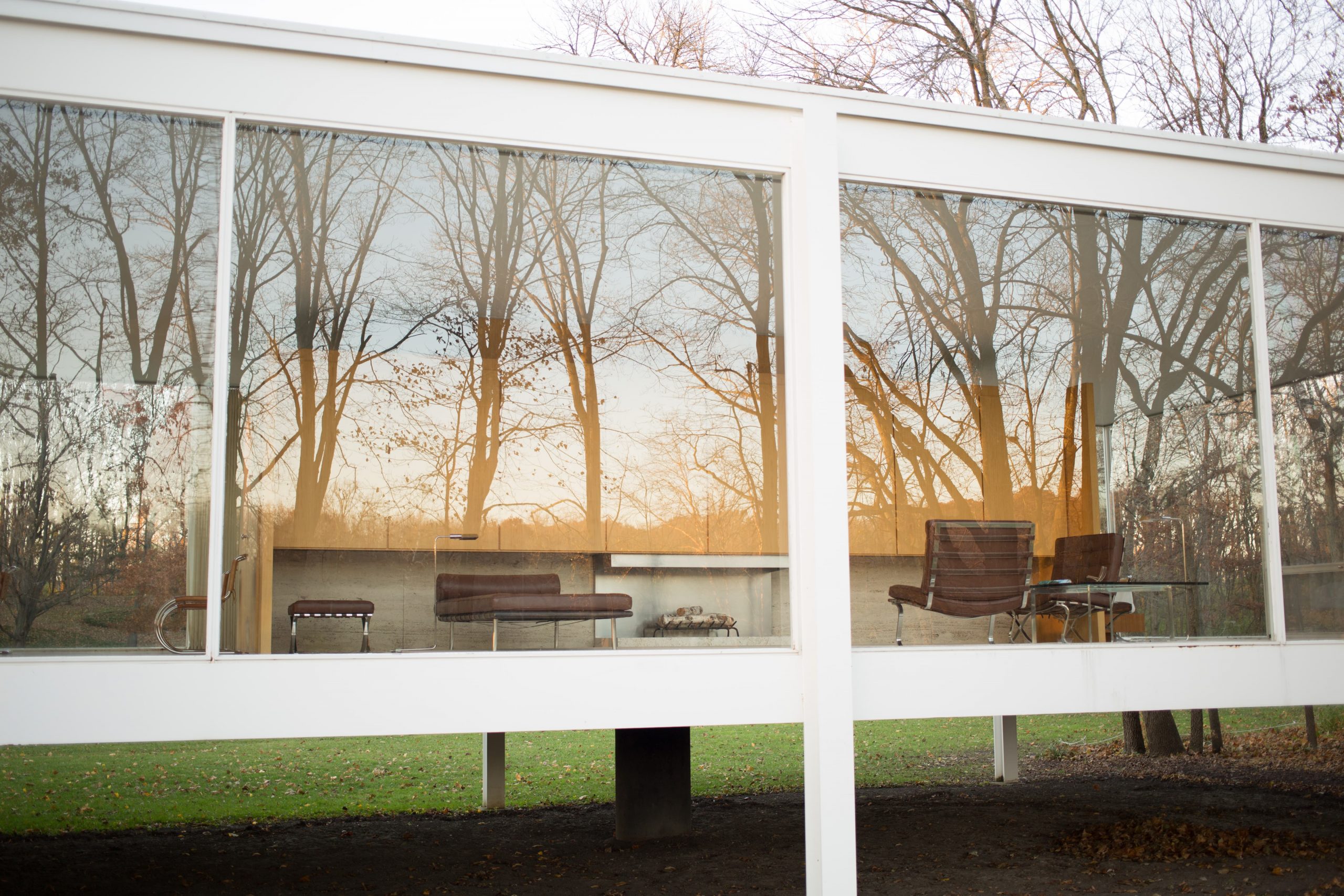
On the banks of the Fox River, eighty kilometers southwest of Chicago, stands the Farnsworth House, designed by German architect Ludwig Mies van der Rohe, discreetly located on the edge of the woods. The building covers an area of just over two hundred square meters and is characterized by its obsessive use of space and, above all, its iconic glass facade.
Preceded by a 123-square-meter access platform, the house consists of a rectangular structure containing all the necessary spaces and services. The entire building is supported by a steel skeleton supported by eight discreet pillars, between which a dozen glass curtains are distributed. These (in addition to the floor slabs) are the only structural elements of the house.
Inaugurated in 1951, the Farnsworth House made architectural history with its obsessive pursuit of simplicity and perfection in detail, instantly becoming a paradigmatic exercise in space management and material discretion. Let’s see how van der Rohe uses glass in this iconic building.
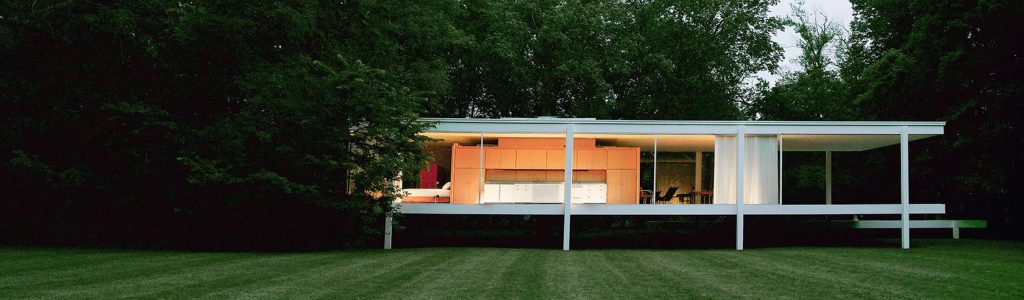
Glass walls for invisible prominence
One of the fundamental aspects of the proposal is the fusion with the natural environment of the house. As mentioned above, the house is located in a privileged setting: a few meters from one of the tributaries of Lake Michigan, it is accessed via a road that runs through the Silver Springs woods.
Van der Rohe had presented a model of the house years earlier at MoMA in New York, but it was not until the architect met Edith Farnsworth that the project took on the dimension of a retirement home, which was what Farnsworth, a doctor from Chicago who owned land on the banks of the Fox River, needed.
Not only does the Farnsworth House have no walls or partitions, it also has no interior walls. The entire house is located in the same space, except for a small area enclosed by wooden walls in the center of the rectangle where the service areas are concentrated: the kitchen and bathroom. Otherwise, all the other spaces in the house (the dining room, living room, bedroom, study) are defined by the furniture.
This makes the building practically invisible, yet it does not sacrifice the personality of the space or the warmth of the interior. How does it achieve this?
- The furniture is intentional and custom-designed by the architect himself.
- The design takes advantage of the surroundings. By using large glass curtains instead of partitions, everything around the house is visible from any point inside or outside the house at any time.
These two factors demonstrate that a glass wall or facade has as much personality as its context. The Farnsworth House is considered a paradigmatic example of Modernist architecture, which advocated the search for beauty through inspiration from nature.
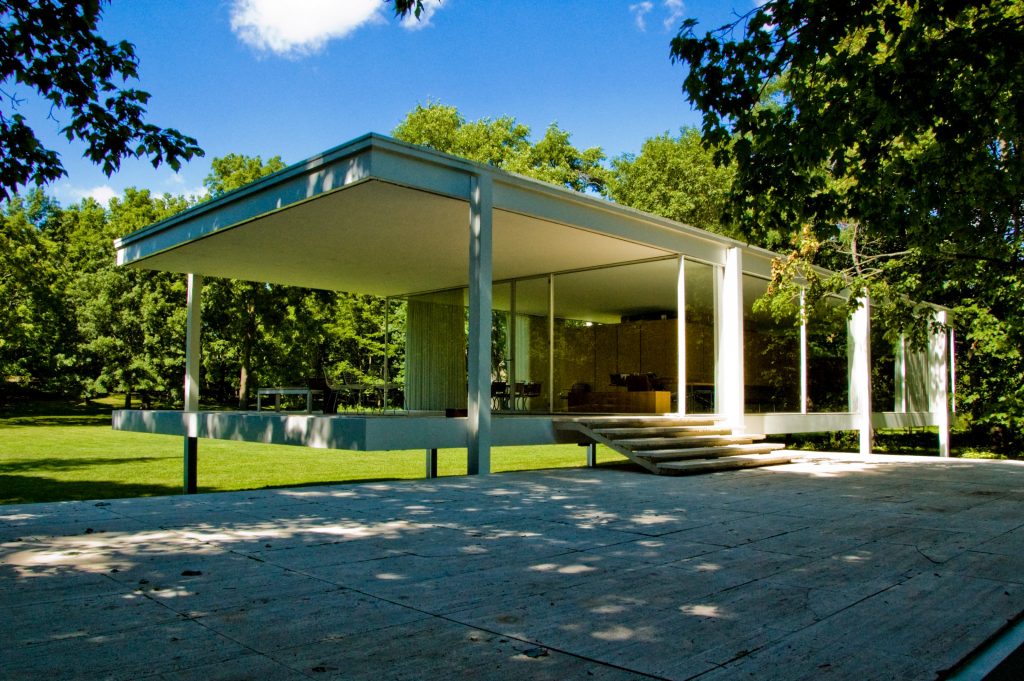
How the Farnsworth House solves the challenges posed by a glass facade
A glass facade presents a number of practical challenges, which the Farnsworth House solves in different ways:
- Lack of privacy. the statement of intent that a glass façade makes implies an immediate and obvious loss of privacy. Van der Rohe proposes the simple solution of fabric curtains around the entire interior perimeter that allow the view to be completely blocked. Throughout the house’s more than seventy years of existence, these fabric curtains have been roller blinds, double curtains, and single curtains, always in light colors.
- Climate control. As we mentioned in this article on the drawbacks of glass curtains, one of the challenges presented by spaces enclosed by glass is climate control. In this case, the solution, which was absolutely innovative for its time, was the installation of underfloor heating. In addition, in the service module that occupies the center of the house, there is a fireplace whose flue discreetly exits above the wooden panels.
- Humidity. Being on the banks of a river (which also tends to overflow from time to time), the humidity level is quite high: an obstacle that the architect circumvents by extending the eight pillars on which the house stands 1.75 meters above the ground, making the house “float” above the ground, isolating it from the soil.
- Structural weakness. The original glass panels were not made of tempered glass, which made the structure vulnerable to pressure from natural elements, especially frost and flooding. Until 2024, two of the original glass curtains had remained intact, but all have now been replaced with sheets of tempered glass, like the ones we use at Glaxior, to preserve the integrity of the house in a future that promises only increasingly extreme weather events.