Bioclimatic architecture, closely linked to the use of materials such as glass and passive design, improves the well-being of users, buildings, and the planet.
Have you ever come across the term “bioclimatic architecture”? If you haven’t, you are about to. Current global conditions compel us to seek adaptation strategies, not only to survive the climate crisis but to thrive in it.
Architecture has been exploring and refining these adaptation strategies since the 1970s. Each decade, place, and movement has given rise to different trends: sustainable architecture, eco-architecture, regenerative architecture… These are different names for a common trend, which is about making our buildings better for people and for the planet.
The method of bioclimatic architecture: analysis, diagnosis, proposal, and prioritization
Bioclimatic architecture is the branch of architecture that seeks to harness natural resources to reduce energy consumption and maximize user well-being while minimizing environmental impact.
It was formally proposed as a discipline in the late 1950s and took shape with the publication of Architecture and Climate: A Manual of Bioclimatic Design for Architects and Planners (1963) by the Hungarian architect Victor Olgyay. This book is an iconic work in the specialized literature that provided the sector with a roadmap for bioclimatic design.
Initially, Olgyay’s proposal outlined a protocol for the environmental adaptation of buildings. His method is based on conducting a bioclimatic analysis to establish clear requirements that can be met as much as possible by taking advantage of environmental conditions rather than fighting against them. This method can be broken down into four phases:
–Analyze the bioclimatic characteristics of the site where the building will be constructed. A precise assessment must be made of the solar radiation, temperature, wind, and humidity that a building would experience throughout the year.
–Assess the effect these factors have on human, animal, and plant physiology. What adaptation measures does the local population implement in their vernacular architecture? Will the building’s intended users be local residents accustomed to the climate, or will it be designed to accommodate visitors who will likely need a period of adjustment?
–Propose an appropriate technological solution to address each issue related to thermal comfort. Living organisms have comfort and safety thresholds regarding temperature, humidity, wind, and radiation. We must seek out the knowledge and techniques that, when applied in a coordinated manner, allow building conditions to be maintained within those parameters.
–The final proposed step is to integrate these technical solutions into an architectural whole according to their importance. In other words, to establish a scale of priorities.
A discipline influenced by the use of materials and climate change
Olgyay’s initial proposal has evolved over the decades, incorporating into the protocol technical advancements that allow architects to perform various simulations and measurements to design far more efficient buildings and eliminate the trial-and-error process that drives up costs and delays completion times.
The popularity of bioclimatic architecture as a discipline has fluctuated over the decades, influenced by industry trends but, above all, by the various crises we have faced, from the oil crises of the 1980s to the current climate crisis. It will become increasingly urgent to implement widespread strategies that allow us to survive the challenges of climate change, and bioclimatic architecture is one of those strategies.

Working with high-quality insulation materials and products: a cornerstone of sustainable architecture
As technical resources in the sector advance, the benefits of bioclimatic architecture are maximized. Products like Glaxior’s glass curtains allow for the use of a type of material that, until recently, was very limited in the field.
Thanks to the precision of our glazing systems, the airtightness of spaces is optimized. Both our sliding and folding curtains allow glazed spaces to be fully open or highly enclosed, which increases thermal comfort and helps control humidity levels.
Our products are compatible with other sustainable climate control solutions. Glass curtains are compatible with vernacular architectural practices and other sustainability initiatives applied to design, urban planning, and architecture, such as the use of vegetation and the maximization of natural light.
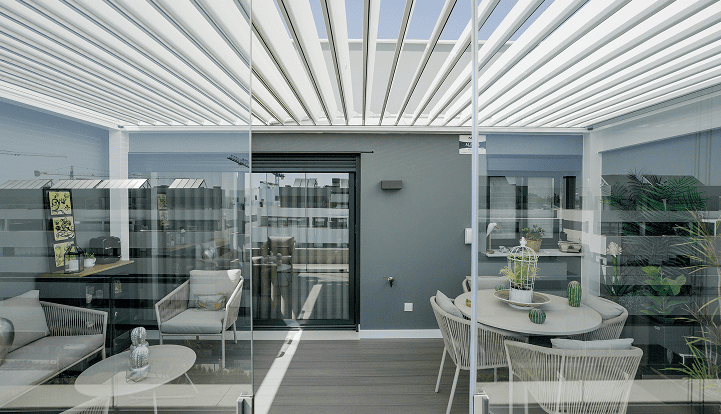
In addition to folding glass curtains and sliding glass curtains, we recently introduced our new bioclimatic pergolas: a product designed and developed using cutting-edge technology that allows you to control the thermal and humidity conditions of a space without enclosing it, and which is compatible with our other products.
Contact our team, and Glaxior’s technicians will explain how our glazing systems can help make your project more energy-efficient and benefit from the principles of bioclimatic architecture.