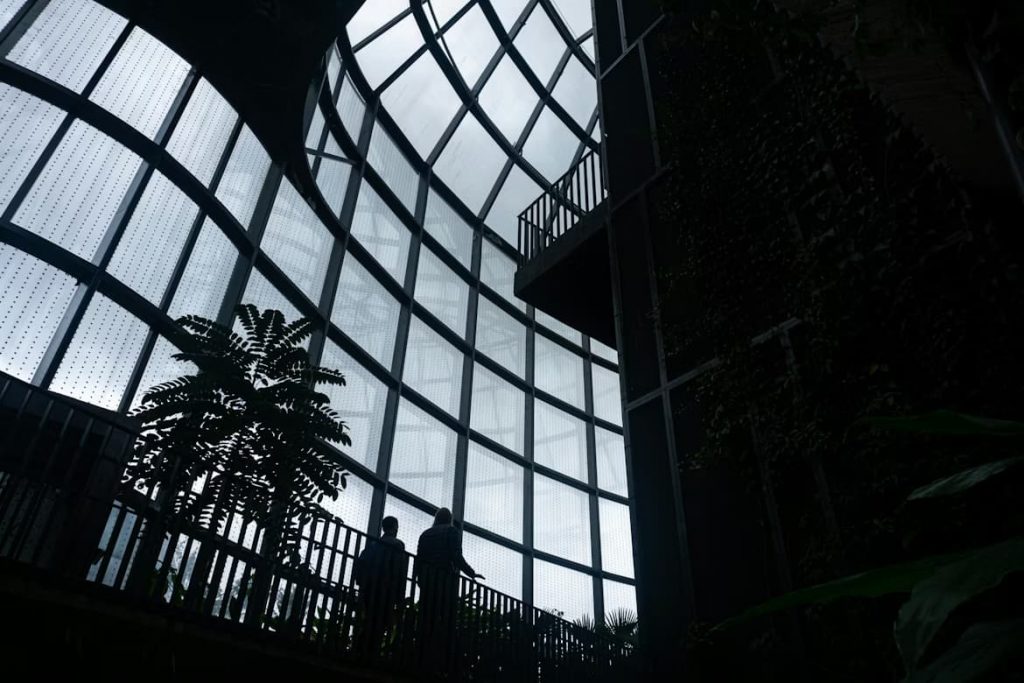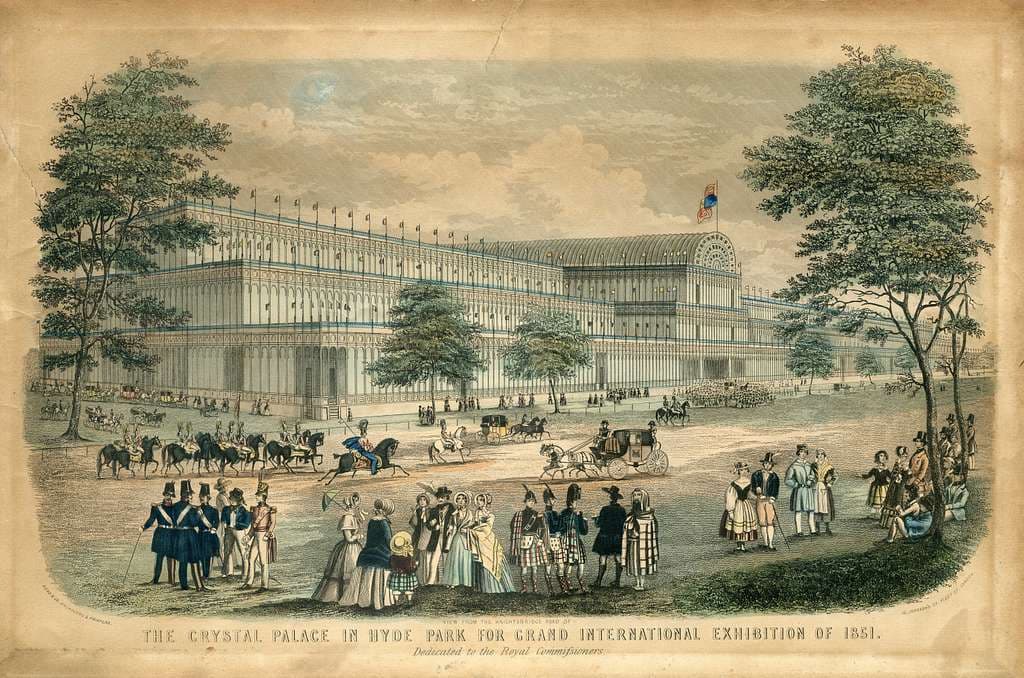
Can a building made mostly of crystal catch on fire? We know glass to be a bad heat conductor, but some episodes in the history of Western architecture put the flammability of the material into question. Such is the case of the infamous Crystal Palace fire.
The Crystal Palace: symbol of the Illustrated Era and milestone of glass acrchitecture
In the middle of the XIXth century, a gardener called Joseph Paxton pitched an original, innovative and frankly genuine solution to the problem that the comitee tasked with the design for the building that would host the Great Exhibition of the Works of Industry of All Nations was struggling to solve.
King Albert had summoned a group of engineers and architects to design a proposal for the Exhibition. The building was to be constructed on Hyde Park, and it had to be walkable end-to-end by visitors in an uninterrupted fashion. Therefore, the interior of the building could not have any stairs or separate rooms; a requirement that none of the existing buildings met.
After months of proposals that didn’t make it very far into the process, delays and pointless interrupted construction works that wasted the alloted budget, a relatively unknown gardener called Joseph Paxton pitched to the comitee a promising idea: to build a large-scale orangerie that could host the Exhibition. These were the perks of constructing a building entirely made of glass curtain walls:
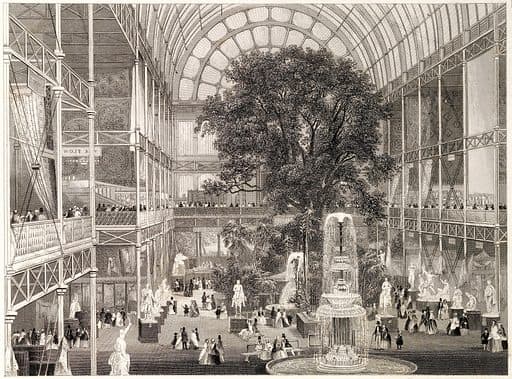
–It met the environmentalist demands. There was a loud sector of Victorian society that demanded to see the biodiversity of the park cared for. Paxton’s design contemplated working over the trees that were already there so they would fit inside the building, unharmed. The fact that the Palace was essentially a big greenhouse made it well received by conservationists that had been really worried about earlier submissions to the project.
–It would be a demonstration of technical proeficiency. The building would be made of equal parts that could be low cost and mass made in record time. It was a modular steel structure covered with glass curtains that would be three times the size of Saint Paul’s Cathedral. In the end, once the project was approved it finished within 190 days.
-After the Exhibition, it could be dissasambled. Not everyone in the high London society was on board with the idea of building a mega-structure in the middle of the park, but the modular design and the lightness of the steel and glass structure made the building not just hypothetically dissasamblable, but made all the materials reusable for other projects.
Flammable materials right next to the glass: the end of the Crystal Palace
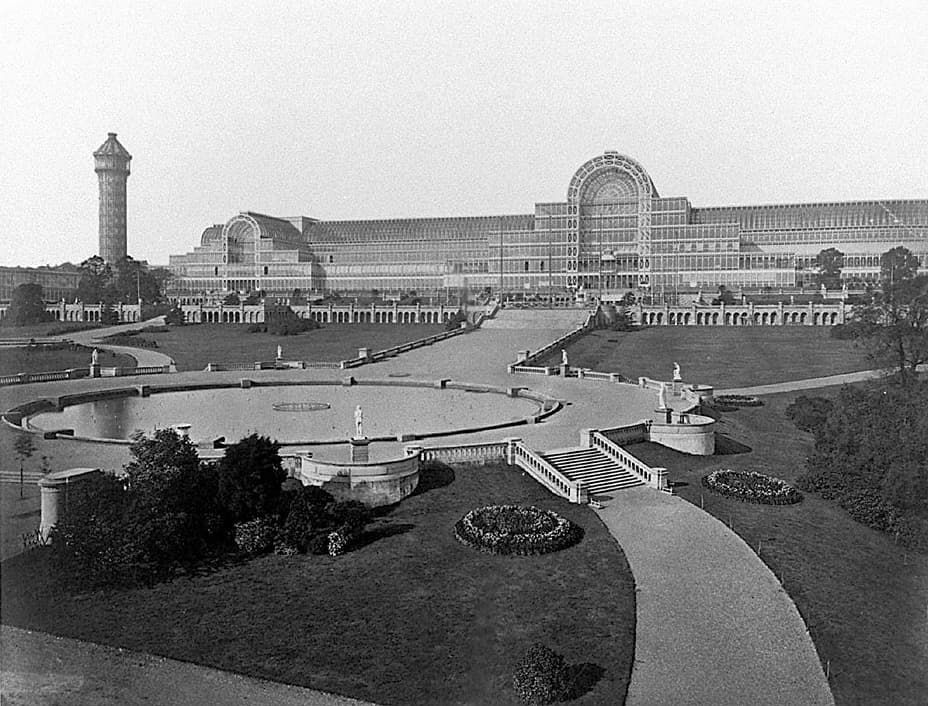
In the end, the building was so successful that it was never taken down, although it was relocated to a different part of London to free the space in the park. Over the next decades, it became a landmark of British culture and a milestone of modern engineering. It was, at the time of its construction, the biggest crystal building in the world.
However, on november 30th 1936, what started as a small office fire ended up spreading rapidly all over the building. The fire was reported around 19:00h, and even though hundreds of firemen tried to contain the flames, by the morning of november 31st the Crystal Palace had been reduced to a mess of molten metal and melted glass.
Only two towers that were structurally independent from the main building survived the fire, but they were demolished shortly after due to safety concerns. The fire provoked both an enormous cultural loss and a big new worry amongst the people of the time about the safety of glass buildings. The Crystal Palace’s aesthetic and structure had been widely and intensely copied all throughout Europe. Could a crystal building catch on fire?
Can a building made of glass catch on fire?
Not as such: glass can’t burst into flames. It is an incombustible material, which means that it can withstand fire without emiting flammable gas nor open flames. What glass does have tho is a fussion threshold, between 1400ºC and 1600ºC. In other words, above certain temperature that will be higher or lower depending on the glass composition, crystal melts.
Strictly speaking, glass can’t catch on fire itself, but the structures and materials around it can. In the case of the Crystal Palace, it is believed that the wooden floor, that had no fire-retardant treatment whatsoever, was the element that rapidly spread the flames all over the central section. The glass broke quickly due to the thermal shock, letting in bigger amounts of oxygen that fed the flames, accelerating the whole process while firefighters were left unable to do anything effective to stop it.
Today we have protocols, legislation and safety materials that diminish in great measure the risk of fie, and minimize the extension of damage in the event of one happening. In the case of glass curtains, we use a special kind of safety crystal called tempered glass. This glass resists much higher temperatures for a much longer time, and, in the event of breakage, it doesn’t fracture in thousands of shreds, but it fragments into granular pieces that can stay put even when fractured.
The fire’s aftermath
After the Crystal Palace’s fire, a number of changes and new legislations were put into place in the UK. For instance, irrigation infrastructure improvements were pushed forward, since the firemen had trouble with water pressure during the fire due to the Palace being at the top of a hill.
The deflagration and combustion times registered at the fire were also taken as baseline to create new evacuation and capacity protocols, particularly for factories.
Also because of the fire, safety measures became a priority in urban planing. Thanks to the fire happening at night, no human lives were lost, but had it happened during the day, total evacuation wouldn’t have been possible due to how fast the fire spread.
Lastly, and more importantly for the issue we are discussing, the Crystal Palace fire defied the Victorian notion of unprocessed glass being fire-proof. It was in the aftermath of the fire that time and resources were invested in developing treatments that made glass more resistant. The formula we currently have for making tempered glass like the one we use for Glaxior’s glass curtains was eventually born from those efforts.
Ever since then the industry has never ceased to invest in innovation and development, and today we can declare ourselves proud heirs of a technological tradition that has at its core the wellbeing and safety of buildings and users.
For installers and distributors
Bring a frameless glass curtain system to your next project
Glaxior manufactures retractable and sliding glass curtain systems for professional projects. Review the technical documentation or talk to our team about product selection, project support and distribution.